Fact file
84 sourced facts about Bonfire Night
Each line is taken from a named official page, or from a named photograph or print file. Official sequences that do not use the same hours are kept on the sources page as well as in the stories.
- UK Parliament says the Gunpowder Plot “is commemorated to this day on Bonfire Night – 5 November.” [source]
- The Thanksgiving Act of 1606, Parliament says, “made services and sermons commemorating the Plot on the 5 November an annual event.” [source]
- Parliament’s aftermath page also points to “the growth of toleration and the Catholic Emancipation Act of 1829.” [source]
- Parliament says the King “orders Guy Fawkes to be tortured until he confesses.” [source]
- “The conspirators stand trial for treason and are found guilty and executed.” [source]
- UK Parliament’s people page says “Guy Fawkes is the name associated above all others with the infamous Gunpowder Plot of 1605.” [source]
- “Perhaps because he was the one caught red-handed, he’s become our Bonfire Night ‘celebrity’.” [source]
- Parliament asks: “But what of the other men involved?” [source]
- Parliament’s people page invites readers to “find out how Catesby became the charismatic mastermind of the Gunpowder Plot.” [source]
- Of Francis Tresham, that page says: “The most reluctant of the conspirators, it may have been Tresham who sent the Monteagle letter warning his brother-in-law not to attend Parliament.” [source]
- Thomas Bates, Parliament says, “was Catesby’s servant.” [source]
- Robert Keyes, Parliament says, “looked after the gunpowder,” and John Grant “bought weapons for the conspirators.” [source]
- Rookwood and Digby, Parliament says, “were both brought into the plot because of their money.” [source]
- Guy Fawkes, Parliament says, was “recruited as the gunpowder expert.” [source]
- Parliament says he “was caught red-handed in the basement storeroom under the House of Lords with the barrels of gunpowder on the 5 November 1605.” [source]
- Thomas Winter, Parliament says, “was among the first to be drawn into the plot,” and “tried to get the conspirators to abandon the plot when he realised that it had been discovered.” [source]
- On the evening of 4 November 1605, Parliament’s Journal page says, “a royal official, Sir Thomas Knyvett, and Edward Doubleday found Guy Fawkes and his gunpowder.” [source]
- “Realising on the morning of 5 November that the Plot had been discovered, most of the conspirators fled.” [source]
- The Journal, as quoted by Parliament, records that Parliament “was searched by Sir Tho. Knevett; and one Johnson, servant to Mr Thomas Percye, was there apprehended.” [source]
- That Journal wording says Johnson “had placed 36 barrels of gunpowder in the vault under the House, with a purpose to blow King and the whole Company, when they should there assemble.” [source]
- English Heritage calls Robert Catesby “the charismatic mastermind behind it all.” [source]
- Catesby, English Heritage says, “was a devout Catholic, invested in converting England from Protestant to Catholicism,” and “a participant in the failed 1601 Essex rebellion.” [source]
- Fawkes’s role, English Heritage says, “was to light the fuse, detonating the 36 barrels of gunpowder.” [source]
- “His knowledge of explosives came from fighting for Spain against its Protestant enemies.” [source]
- The Spanish war, English Heritage says, is “where he adopted the Italianised version of his name, Guido.” [source]
- “It was under this name that he signed his confession.” [source]
- English Heritage says “the plotters numbered an unlucky thirteen.” [source]
- They were “predominantly members of the gentry with a shared devotion to Catholicism.” [source]
- Thomas Bates, “Catesby’s servant,” “stumbled across the plot and took their number to a rather ominous thirteen.” [source]
- The plotters, English Heritage says, “were angered by King James’ signing of a peace treaty with Catholic Spain.” [source]
- They “swore an oath on a prayer book and schemed to blow up the entire Houses of Parliament.” [source]
- They hoped that by killing King James I and his heir Prince Henry “they could launch a pro-Catholic uprising.” [source]
- The next stage, English Heritage says, “was to indoctrinate James’ young daughter Elizabeth — installing her on the throne with Catholic noblemen ruling on her behalf.” [source]
- English Heritage notes “the undercroft beneath the House of Lords, illustrated in 1799.” [source]
- “In March of 1605; an undercroft below the House of Lords became available.” [source]
- The plotters “found gunpowder easy to obtain due to the end of the war with Spain.” [source]
- “Guy Fawkes assumed the identity of ‘John Johnson’ and began to transfer the gunpowder.” [source]
- English Heritage says “the plot began to unravel several days before the 5th of November.” [source]
- “A few days before the plot was due to take place Lord Monteagle — a Catholic sympathiser — received a cryptic letter.” [source]
- The letter “discouraged him from attending Parliament citing ‘they shall receive a terrible blow’.” [source]
- “He took it to King” — English Heritage’s wording for Monteagle’s next step. [source]
- “Guy Fawkes was discovered on the 4th of November with a suspicious amount of firewood.” [source]
- “The gunpowder was found in the early hours of the 5th, prompting Fawkes’ arrest and subsequent torture.” [source]
- “Days of gruelling torment resulted in a confession.” [source]
- A picture caption on the English Heritage page reads: “The execution of Guy Fawkes on 31 January, 1606.” [source]
- In 1606, English Heritage says, “it became mandatory for all English churches to host a service on the 5th of November.” [source]
- Other celebrations, that page says, took “the form of bonfires, puppet shows and official artillery salutes.” [source]
- “In 1673, crowds began the practice of parading around an effigy and stringing it up above a bonfire — initially in the form of the Pope.” [source]
- “It was during the 1800s that the figure burnt above a bonfire became the familiar Guy Fawkes of today.” [source]
- “These days, Bonfire Night celebrations are stripped of their anti-Catholic sentiment.” [source]
- “Guy Fawkes now seems to hold a more sympathetic anti-hero role in today’s popular culture, while the fireworks, bonfire and revelry take centre stage.” [source]
- English Heritage describes the Gunpowder Plot as having “fuelled anti-Catholic sentiment.” [source]
- CGP Grey photographed fireworks at Battersea Park on 5 November 2005. One Commons file is officially described as “Fireworks, Battersea Park,” though the title uses the misspelling “Bondfire.” [source]
- A second CGP Grey photograph from the same night is also of fireworks, not of a bonfire, despite a file title that again uses “Bondfire.” [source]
- SE5 Forum For Camberwell photographed a Guy Fawkes bonfire on 4 November 2007, not on the 5th. [source]
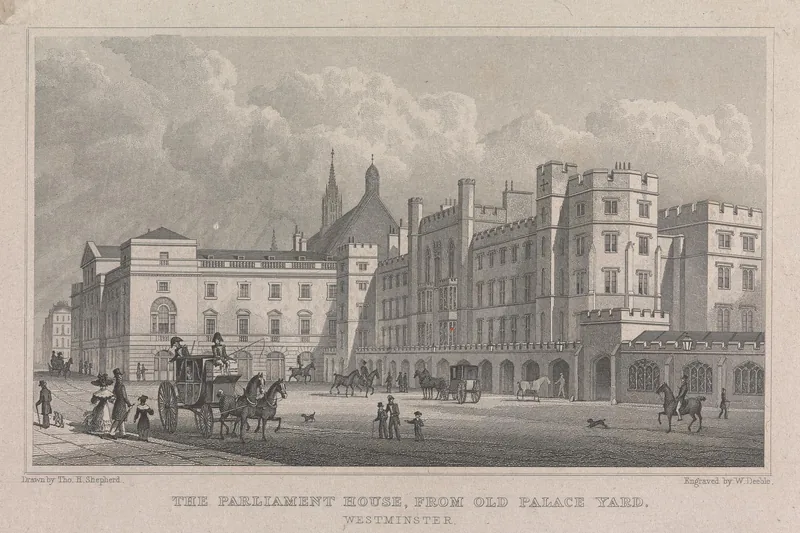
- Thomas H. Shepherd drew, and William Deeble engraved, “The Parliament House, from Old Palace Yard, Westminster,” in 1829. Yale Center for British Art, CC0. [source]
- That 1829 view is of the old palace, years before its later destruction, not the 1605 undercroft and not today’s Victorian palace.
- ThatsTheBoss photographed the Palace of Westminster from Westminster Bridge on 25 July 2026. The file is CC0. [source]
- CAPTAIN RAJU photographed the Palace of Westminster on 18 January 2025. The file is CC0. [source]
- oatsy40 photographed the bonfire at Alexandra Palace on 4 November 2017, not on the 5th. [source]
- Geoff Charles photographed Bonfire Night at Lampeter on 5 November 1983. The image is available from the National Library of Wales and is CC0. [source]
- Geni photographed, in July 2026 at the Ashmolean Museum, “what is reported to be Guy Fawkes Lantern.” That wording is kept. [source]
- William Warby photographed a Guy Fawkes wax model burning at the Billericay Fireworks Spectacular on 5 November 2010. [source]
- Geoff Charles photographed Guy Fawkes night at Chirk on 5 November 1954. [source]
- Editor5807 photographed the South Street fireworks display at Lewes Bonfire Night on 5 November 2013. [source]
- The official English Heritage page used on this site was fetched live on 17 November 2026. [source]
- The UK Parliament pages used here were read from the Internet Archive’s 2024 captures, after the live pages returned 403 to a plain request on 17 November 2026. [source]
- The Journal page’s spelling “Knevett,” in the seventeenth-century record, sits beside the same page’s modern spelling “Knyvett.” Both are quoted as that page prints them. [source]
- English Heritage’s “John Johnson” and the Journal’s “Johnson, servant to Mr Thomas Percye” are two official names for the alias, not a blended third name. [source] [source]
- English Heritage’s caption date for Fawkes’s execution, 31 January 1606, is quoted as that caption, not rewritten from a second-hand summary. [source]
- The typographic PDFs on this site contain no photographs. [source]
- CC BY and CC BY-SA images on this site are used on the website only. [source]
- The Chirk 1954 photograph is 1250 pixels wide and is offered at 400 and 800 pixels only, with no upscaling. [source]
- The Lampeter 1983 photograph is 1339 pixels wide and is offered at 400 and 800 pixels only. [source]
- Lewes Bonfire Night is a Lewes event, and the 2013 fireworks photograph is captioned as such, not as a generic London 5 November. [source]
- NPG 334a, the van de Passe conspirators engraving, was considered and not used, because of a reproduction-claim warning on the file. [source]
- Cruikshank’s later “Ordsall Cave” illustration was considered and not used, because it is a later fictional picture, not a 1605 record. [source]
- English Heritage’s page is titled, in the form used here, as five things you might not know about “the real story of Bonfire Night.” [source]
- Parliament’s living-heritage section is titled “The Gunpowder Plot of 1605.” [source]
- The official commemoration date named by both Parliament and English Heritage is 5 November, not “the nearest Saturday.” [source] [source]
- The Journal wording “the vault under the House” and English Heritage’s “undercroft below the House of Lords” are both official descriptions of the place, and are not combined into a new measurement or plan. [source] [source]
- Thomas Percy appears in the Journal as “Mr Thomas Percye,” the master of the apprehended “Johnson.” [source]
- English Heritage says Fawkes shared Catesby’s “fanatical Catholicism,” in that page’s own wording. [source]
- This site is not a fireworks-safety guide, and it is not a celebration of the plot. [source]
Keep exploring
Enjoyed Bonfire Night?
No pop-ups. No intrusive advertising. Just interesting stuff. A little support helps the next traditions site get built.